

October 12th: Beyond the “Discovery of America” – The Violent Clash That Made Us Who We Are
There was a time when October 12th was simply known across school textbooks as the day we celebrated the “Discovery of America.” Today, that framing feels like a distant memory.
Depending on where you are in the world, the date carries very different names: Día de la Raza, Día de la Nación Pluricultural (Day of the Pluricultural Nation), Columbus Day in the United States, or Día de la Resistencia Indígena (Day of Indigenous Resistance).
Yet, regardless of the label we assign to it, October 12th marks a single pivotal moment in human history: the encounter of two vast, distinct worlds, Europe and America, that had remained completely unknown to each other until 1492.

An Encounter? Or a Violent Clash?
Back in 1992, during the 500th anniversary of this event, official narratives heavily promoted the phrase “The Encounter of Two Worlds” (El Encuentro de Dos Mundos). But in Mexico, many of us jokingly, and accurately, offered a correction. It wasn’t just an encounter; it was an “encontronazo”, a violent, cataclysmic collision.
That meeting was far from peaceful, but it undeniably shaped the world we live in today.
It wasn’t just a local event, either, it reshaped the entire planet. Almost overnight, humanity had to digest monumental truths:
- The Earth was definitively round and navigable.
- Global trade was possible, connecting distant lands and resources.
- Human beings existed on the other side of the ocean who were entirely different in culture, language, and worldview.
To understand the weight of this moment, we have to look past the European perspective. For the Indigenous peoples of the Americas, the arrival of these strange newcomers felt almost alien, an unexpected arrival that drastically dismantled their way of life and laid the foundation for an entirely new way of thinking, trading, eating, celebrating, and governing.
The Persistence of Indigenous Heritage and Mestizaje
For many Indigenous nations, what remained was a tragic memory of what once was, alongside a extraordinary story of survival. Today, that legacy lives on deeply through mestizaje, the blending of cultures that defines modern Mexico.
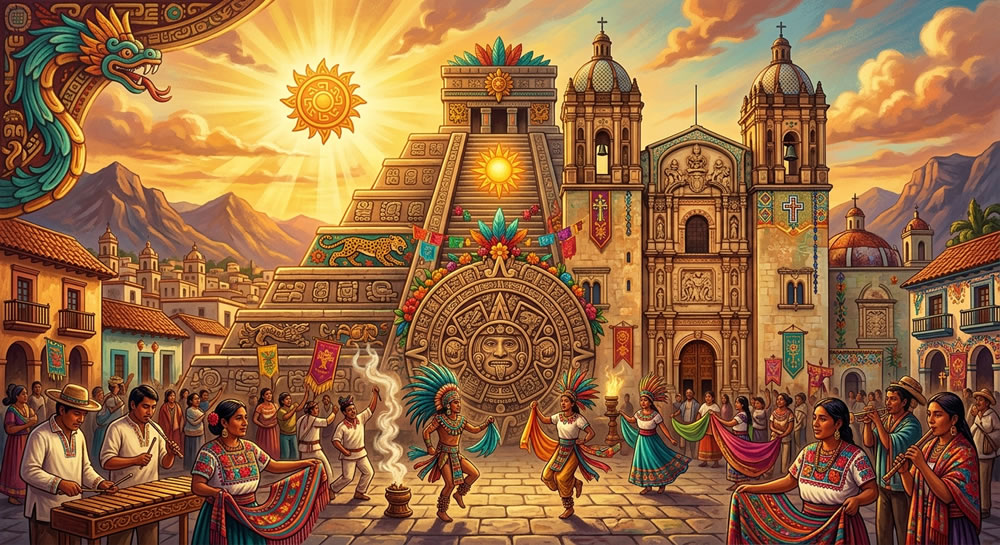
We are a new people: not strictly European, not strictly ancient Indigenous, but a unique fusion of both. You can see it every single day:
- In our refusal to abandon staple traditions like tortillas, chiles, and the vibrant celebration of Día de Muertos.
- In our language, food, art, and daily habits.
At the same time, we must acknowledge that distinct Indigenous communities continue to live in Mexico today. Many still resist and survive under difficult conditions in remote regions, a living reminder of a debt of justice and social equality that our society has yet to pay.
Beyond Good and Evil: A Nuanced Heritage
When reflecting on October 12th, people often ask: Was the conquest good or bad?
That question is a dead end. History isn’t painted in simple black and white; it unfolds in endless shades of gray.
On one hand, we cannot ignore the brutality and violence with which Europeans conquered these territories. On the other, in Latin America, they established systems of government, institutions, legal frameworks, and sprawling cities that remain our inheritance today, for better or worse.
For modern, mestizo Mexico, Europeans are just as much our ancestors as the native peoples were. We have inherited a worldview that is deeply Eurocentric, one so embedded in our institutions and modern culture that we cannot simply erase it, even if we tried.
A Rich, Complex Identity
At the end of the day, we are a society immensely rich in history and culture. We stand as the direct heirs to an astonishing mosaic of civilizations:
- From the Old World: The philosophy of Greece, the infrastructure of Rome, and the artistic and mathematical contributions of the Arab world.
- From the New World: The monumental legacies, in Mexico, of the Olmecs, Teotihuacanos, Mayans, and Aztecs.
It is a complex, turbulent history, but one we can hold with immense pride.
And as for everything that came out of it, the good, the bad, and the beautifully complex mix we live today? Well, yes… we can ultimately blame Columbus!

