
We Lost to England… Or Did We Win?
By Carlos Brito
I’ve often thought that my generation and my parents’ generation grew up with a defeatist mindset. We didn’t truly believe in the value of what was “Mexican.” This was true despite living, directly or indirectly, through the “Mexican Miracle” from the 1940s to the 1970s—an era when the country’s economy grew at a steady pace and many people, like my parents, managed to achieve upward socioeconomic mobility.
Yet, we used to assume that if a scientist, an athlete, an engineer, an artist, a product, or art itself was Mexican, it was inherently inferior in quality and craftsmanship compared to anything coming from developed nations in Europe or the United States. If it was Mexican, it was automatically second-rate.
Whatever the reasons behind that phenomenon, the mindset is shifting drastically. Lately, not a day goes by without good news about what Mexicans are achieving both at home and around the world, even in fields where we lack a deep-rooted tradition, like science and technology. It’s no longer surprising to hear about a group of youth traveling to Japan to win an international robotics competition, a cyclist leading the pack in European races (like Isaac del Toro), or a figure skater (Donovan Carrillo) winning international awards when we barely have ice rinks in Mexico.
The list goes on across all fields: Hollywood filmmaking (Guillermo del Toro, Alfonso Cuarón, Alejandro González Iñárritu); orchestral conducting (Alondra de la Parra); acting (Salma Hayek, Damián Alcázar, Diego Luna); and brilliant scientists who, while not household names, are making waves (Mario Molina, Miguel Alcubierre, Julieta Fierro, Eduardo Matos Moctezuma). Not to mention the arts: Elisa Carrillo in classical ballet, Francisco Toledo in painting, or Javier Camarena in opera. We could go on forever listing outstanding Mexicans in every sphere of human endeavor.

This is just a personal reflection, but I believe it is grounded in facts: we Mexicans no longer view victory as something distant and impossible, but as a reality that, while requiring immense effort, is absolutely within reach.
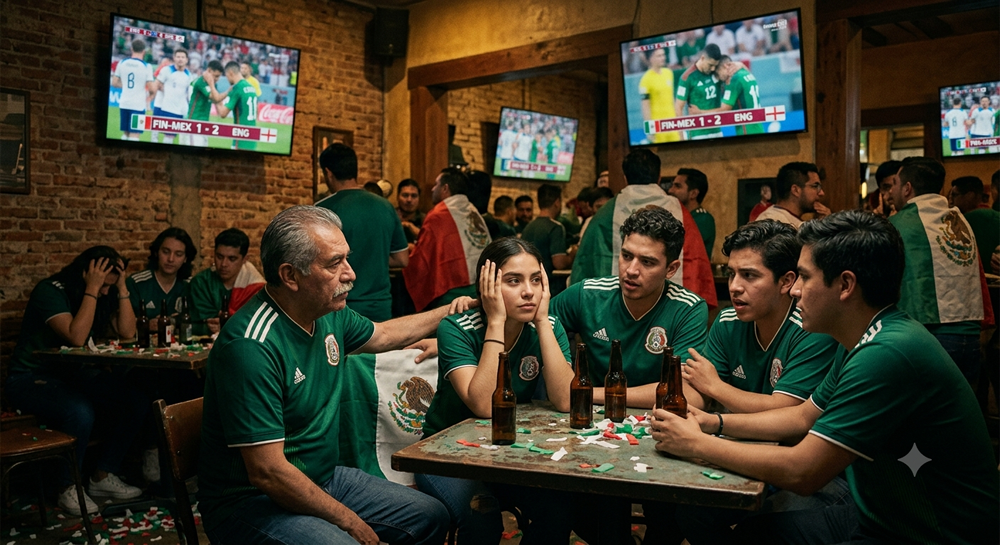
Yesterday, the Mexican national soccer team lost to England in the World Cup after a beautiful run of four consecutive victories. Expectations were high, fueled by the intense passion that soccer ignites in Mexico: packed streets, people celebrating every single goal as a personal triumph, and above all, that festive spirit that defines us. But we lost.
Yet, unlike past World Cups where defeat felt like a humiliation and the team was heavily criticized, this time the fans showed gratitude. They played the way the game is meant to be played: with the discipline, strength, and enthusiasm of a team that goes out to win, rather than one playing defense just to avoid losing. Falling to England left us with the bittersweet taste of someone who leaves everything on the field until the very end, fully aware that winning was possible.
There is a world of difference in that shift—going out to win rather than playing not to lose. We used to pray just to avoid a catastrophic defeat; today, we play to win fair and square. This is the new generation of Mexicans who, as the popular saying goes, “no le tienen miedo al éxito”—are not afraid of success.

